Today, we're launching Practice View, the practice side of our Autonomous Bookkeeping Platform. Here's what it is, why we built it, and what it means for your firm.
There's a version of this post that starts with a statistic of how many hours are lost to manual bookkeeping each year. We've written that version before; it's both true and striking. But the more honest place to start is with something we've heard in conversations with practice owners across Ireland and the UK over the past few years.
It's usually some version of: "we know there has to be a better way to do this, but nothing we've tried has actually changed how bookkeeping work gets done."
We know there has to be a better way to do this, but nothing we've tried has actually changed how bookkeeping work gets done.
They've tried the software. They've tried outsourcing. Some have hired. Some have restructured entire teams. And yet bookkeeping still consumes the most hours, creates the most bottlenecks, and delivers the least margin. It's the work that has to happen before the real work can begin.
Today, we're sharing something we've been building towards for a long time: Autonomous Bookkeeping as a category, and Practice View as the first release of our platform designed specifically for accounting firms.
What we mean by Autonomous Bookkeeping
The word 'autonomous' gets thrown around a lot in technology, so it's worth being precise about what we mean.
Autonomous Bookkeeping is not a faster way to do manual work. It's not software that helps someone reconcile a bank account more efficiently, or a tool that scans a receipt and drops it into a queue for a human to review. Those are useful, but they still assume a person is doing the bookkeeping somewhere. They reduce friction within a manual process. The process itself doesn't change.
What we've built is fundamentally different – made for the AI era. Outmin works with Rex™ , our AI-native engine. Rex doesn't assist with bookkeeping. Rex does the bookkeeping.
Rex: the AI bookkeeping engine behind it all
In Outmin, bookkeeping work flows through four stages, continuously, in the background, for every client:
- Rex Collect pulls in financial documents from every source. Bank transactions through Open Banking APIs, supplier invoices from portals and emails, sales data from point-of-sale systems, payroll reports, merchant data from Stripe, Shopify, Square, and more.
- Rex Process converts raw data into accurate, structured ledger entries. It reads documents, extracts line-level detail, applies the right account codes and VAT treatment, and posts to the general ledger.
- Rex Reconcile matches activity across every financial account: banks, accounts receivable, accounts payable, VAT, payroll, merchants, and control accounts.
- Rex Close locks reconciled books at the end of each period, running completeness checks, validating ledger integrity, surfacing exceptions, and producing financials that are audit-ready.
This happens every day, quietly, in the background. The result is what we call the ActiveLedger™: a continuously reconciled ledger system your whole team can work from. When your team logs in, the books are already done.
Why we built this
We founded Outmin in 2020 because we believed that the economics of bookkeeping were broken for businesses and accounting practices, and that the existing tools weren't going to fix them.
The traditional model works like this: a practice takes on a client, assigns someone to manage the bookkeeping, and that person spends their time collecting documents, entering data, reconciling accounts, and preparing things for review.
The software they use might be excellent. But the person still has to do the work. And the more clients you take on, the more people you need. Bookkeeping scales linearly with headcount, which means margins get thinner as you grow.
We thought there was a better model. One where the bookkeeping work itself is handled by technology, and the practice's role shifts to oversight, review, and high-value services.
Where adding more clients doesn't require adding more bookkeepers. Where the economics actually improve as you scale.
That's the model we've been building. And today's launch makes it tangible.
Outmin: The Autonomous Bookkeeping platform
Outmin is built around one idea: one system, with the right view for the right user.
Business owners see their financials through Business View. Accounting practices see everything, across every client, through Practice View. Same platform, same engine, same books. Today, we're launching Practice View.
Practice View: What you see when you log in
If Rex is the engine, Practice View is the window into everything it produces.
Practice View is designed for one main purpose: to give accounting practices complete visibility into the status of their clients' books without requiring them to manage the underlying work.
See every client. Check what’s reconciled, what's in progress, what needs attention and what's ready to go.
We built it this way because of something we kept hearing from practice owners. As one of our early partners put it: “I don't want to manage the work. I want to see that it's done.” That insight shaped the entire product.
“I don't want to manage the work. I want to see that it's done.”
Practice View isn't a task manager. It's a live, continuously updated overview of the work Outmin is doing.
1. Process visibility
At a glance, practices can see:
- Reconciliation status across the entire client portfolio, with clear signals for what's complete, in progress, or needs attention
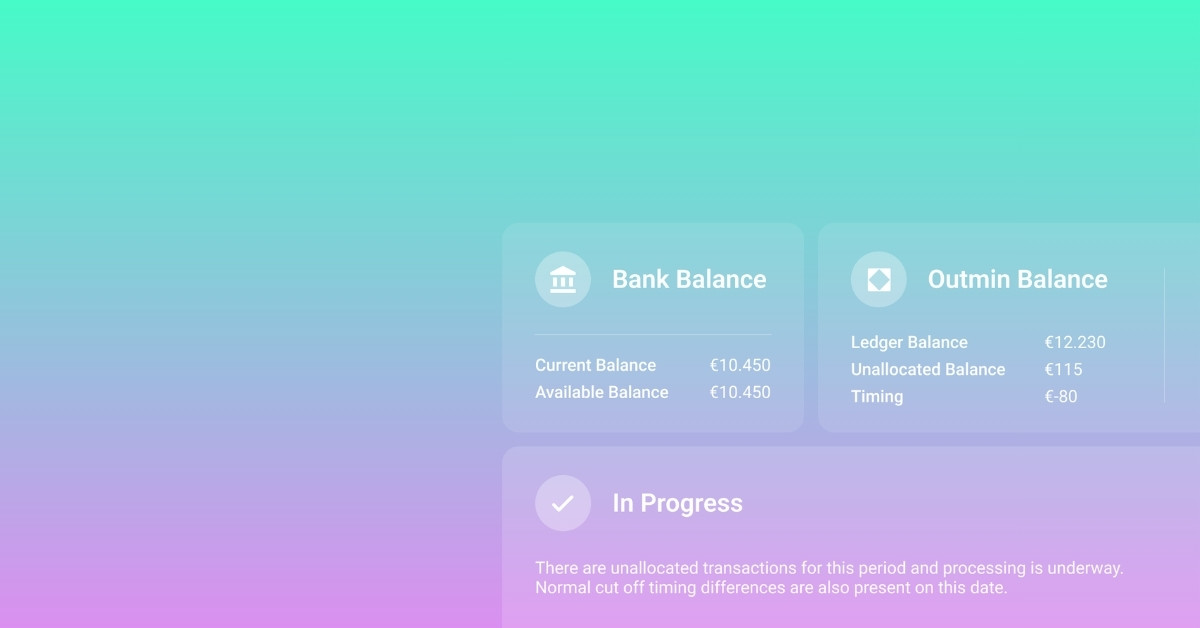
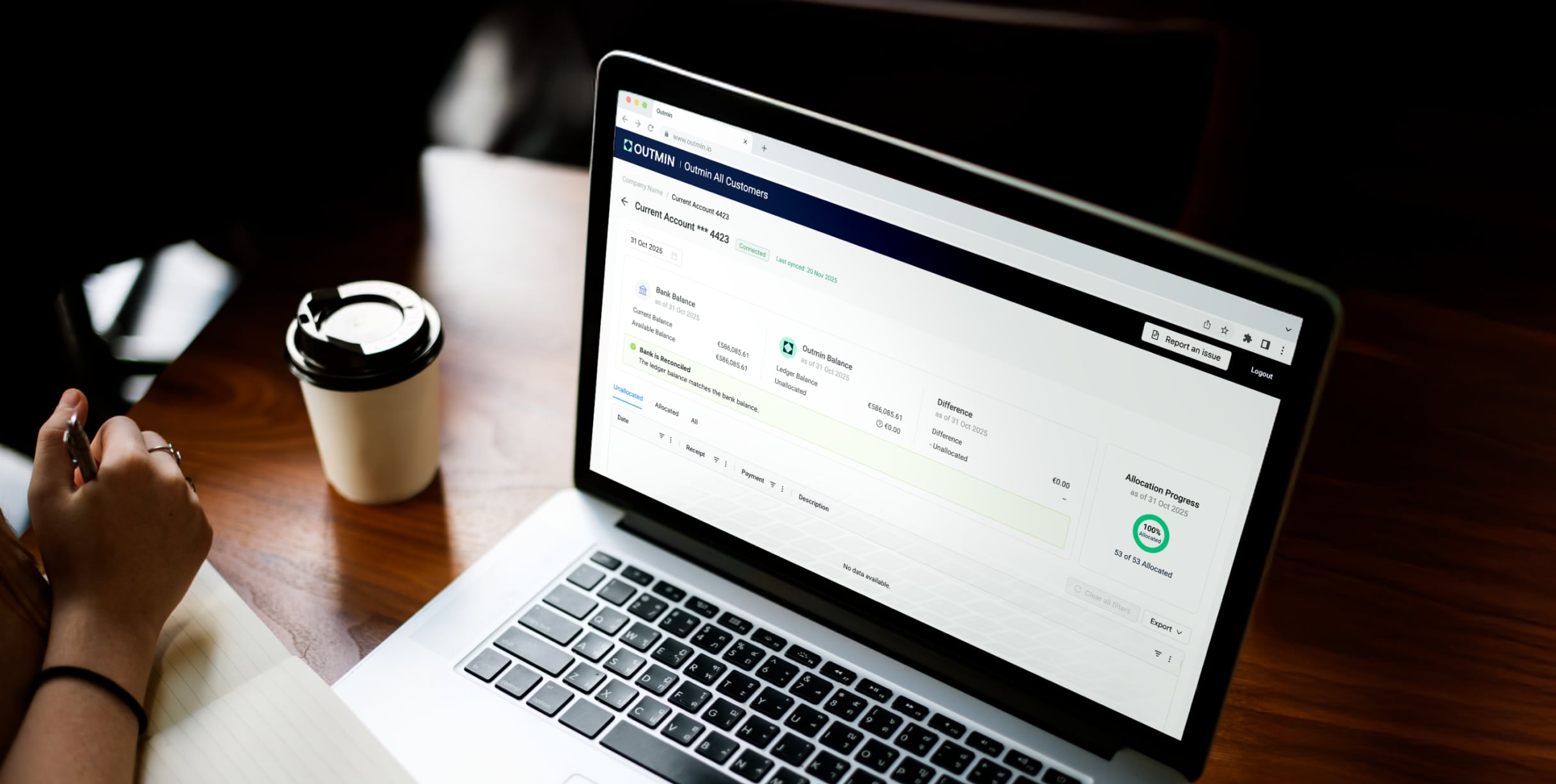
- Bank reconciliation detail for each client, including bank balance vs. ledger balance comparison, allocation status, and account health evaluated by Outmin's algorithm based on historical patterns
- Supplier reconciliation inside the product, replacing static spreadsheets. Every supplier has a single view with connection status, last reconciled date, open issues, ownership, and full statement history
- VAT review with every line item visible: supplier, document type, VAT rate, and treatment. Practices can flag issues directly in the product, and those flags are tracked to resolution. The ability to prepare and file VAT directly in the product is coming shortly, so the full workflow from review to submission will live in one place
- All Documents: a full, searchable view of every document processed through the system, with source, status, classification, and automated notes explaining any exclusions. One of our users put it simply: “everything is the bookkeeping. If the documents aren't right, nothing is right”. All Documents gives practices the ability to verify exactly that, at any time, for any client.
2. Financial outputs, ready to use
Practice View surfaces the full set of standard bookkeeping outputs:
- General ledger, interactive and filterable
- Drillable Trial Balance
- AP and AR ledgers
- VAT workings
- Bank reconciliation reports
All continuously updated, all accessible without waiting for month-end. Every transaction links back to its source document, so verifying any number is a click away rather than an email and a 24-hour wait.
Built alongside the practices who use it
Practice View wasn't designed in isolation. It was built in close collaboration with our early accounting partners, including Nexiō and Xeinadin, who have been instrumental in shaping how autonomous bookkeeping should run at scale.
These practices manage bookkeeping across large client portfolios every day. Their feedback has been invaluable, not just in terms of what features to build, but in how to present information so that it's genuinely useful for an accountant with twenty clients to review before lunch.
It was a partner at one of these firms who told us that what mattered wasn't seeing a to-do list. It was seeing that the work was already done. That framing became the foundation of Practice View. The work happens in the background. The confidence is what surfaces.
What this means in real terms
We're careful about making claims, so we'll share what we've observed across the practices already using the platform.
Practices are seeing a reduction in bookkeeping hours of up to 80-90%. That's not a projection or a target. It reflects what's happening with live clients today. When bookkeeping work is handled autonomously, admin and data entry, document chasing, bank reconciliation, and month-end cleanup simply goes away.
What's been most striking to us is how that time gets redirected. For some early-adopter practices, entire teams have moved out of bookkeeping work altogether.
Staff who were spending their weeks on data entry, reconciliation, and document chasing are now free for compliance, advisory, and client-facing work. They haven't been made redundant. They're now managing work that is more valuable for the practice and more fulfilling for them.
That shift has had a direct impact on profitability, because advisory and compliance work carries significantly better margins than manual bookkeeping ever could.
Some practices have seen capacity increases of 50% on the same team size. Partners who were doing delivery work are back in strategy and growth roles. The month-end scramble, which for many firms was the defining rhythm of every period, has been replaced by books that are continuously ready.
Where we go from here
The launch of Practice View is just the beginning.
Our platform will continue to advance, driven by an exciting roadmap and shaped by the practices using it daily, with ongoing improvements, deeper features, and new integrations planned.
This release, however, is focused entirely on accounting practices. If you are an accounting firm owner who believes there's a more efficient way to manage your team's workload, we designed Practice View for you.
We’d love to show you how it works.
Practice View is available now for accounting practices across Ireland and the UK.